Life Cycle and Habitat
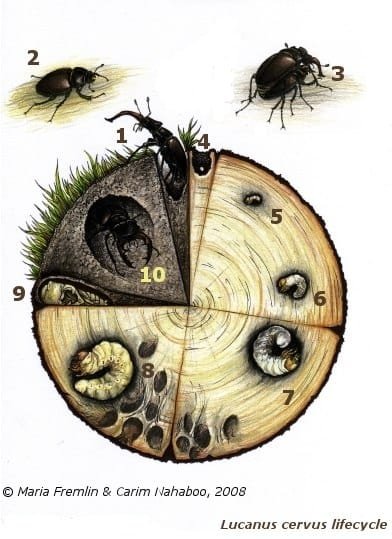
The life cycle of a stag beetle begins when the female lays her eggs in decaying wood. The larvae, which are small and white, feed on this rotting wood for several years in forests. After several years, the larvae pupate and developed as adults.
Adult stag beetles primarily feed on tree sap and decaying fruits. Despite their fearsome appearance, they are harmless to humans and play a crucial role in the ecosystem by helping to decompose dead wood.
The Life Cycle of Stag Beetles
Stag beetles have an interesting and complicated life cycle that lasts for several years. Every phase is essential for their growth and the ecosystem.
- Egg Stage:
- The life cycle starts when a female stag beetle lays eggs in decaying wood or soil which is rich in organic matter. Each female beetles can lay up to 30 eggs.
- The eggs hatch within a few weeks.
- Larval Stage:
- As soon as they hatch the larvae (grubs) start eating the rotting wood
- This stage time can last between one to five years.
- The larvae are pale white with a distinct brown head and powerful mandibles, which they use to chew through wood.
- During this stage, The larvae enhance the decomposition process by break down dead wood and recycling nutrients back into the soil.
- Pupal Stage:
- After several years of growing and feeding, the larvae enter into the pupal stage. They create a pupal chamber in the soil or within the decaying wood where they have been feeding.
- Inside this chamber, the larvae undergo metamorphosis to transform into adult beetles. This stage can only last several months.
- Adult Stage:
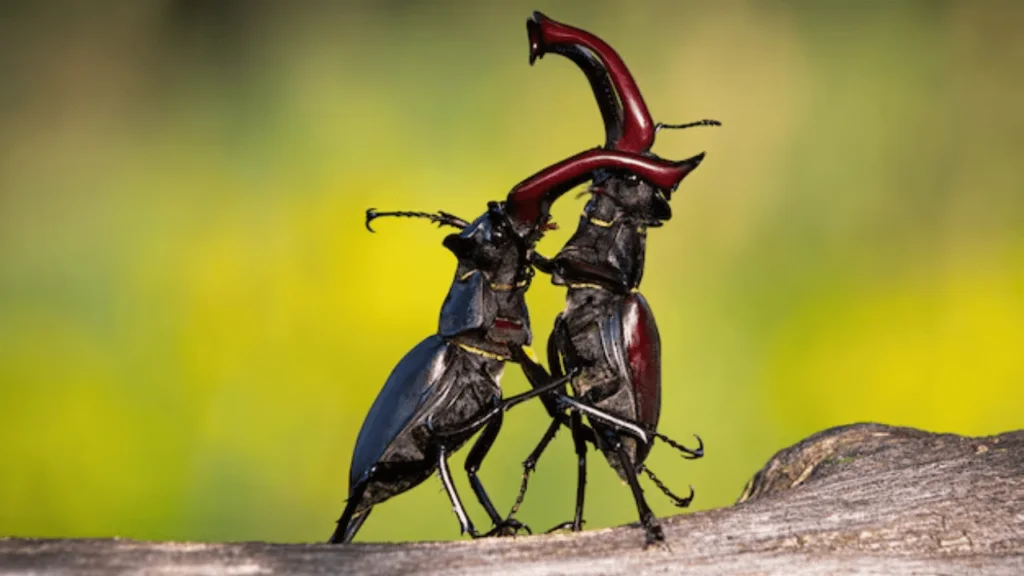
- The adult stag beetles usually come out in late spring or early summer from Pupal Chamber. Males have large, antler-like mandibles, while females have smaller mandibles.
- Adult stag beetles mostly eats tree sap and decaying fruits as their favorite food. They are most active in warm evening and are mostly flying and searching for mates.
- Their adult stage lasting only a few months. During this adult stage, their prime focus is on reproduction. After mating, females lay eggs and the cycle begins a new.
Importance and Conservation
Stag beetles are very essential to our environment. They break down the dead woods and add nutrients back to the earth, which is like nature’s recycling machine. But in many places, their population is going down because they are losing and fragmentation of their habitat. In some countries, stag beetles are endangered species, so in many countries and government conserve this species. Which make it very expensive and created demand in market. 6 grams of Stag Beetle Cost $90000 USD
How to Make Stag Beetle Farm to earn $100 Million USD
Just like their lifecycle here we going to unveiling their Habitats of Stag Beetles, Which is the essential information every farmers should know.
Mostly, stag beetles live in rotting wood. It like to live in woods and deciduous forest and woodlands. There they can get lots of dead and rotting wood in those places, which is very important for their larvae.
The Habitats of Stag Beetles
- Woodlands and Forests:
- Oak, beech, and other hardwood trees are particularly important in their habitats list as they have large amounts of decaying wood.
- Gardens and Parks:
- Hedgerows and Farmland:
If you want to grow stag beetles, consider the above habitats and create a beetle-friendly environment in your farm or garden. Fill it with dead wood in a every corner of the farm to provide a habitat for these fascinating insect.